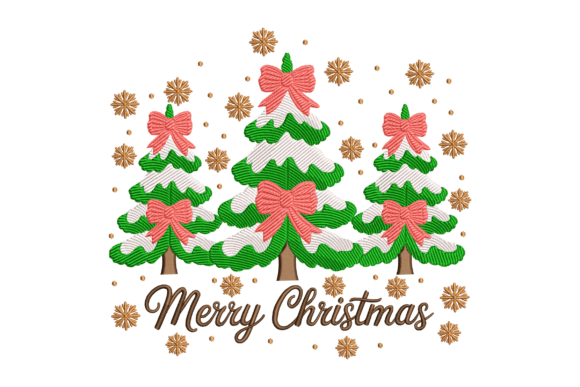
Merry Christmas Trees
A Thoughtful First Impression for Real Projects
When I opened Merry Christmas Trees on Creative Fabrica, I wasn’t scanning for holiday cheer—I was assessing viability. As someone who ships embroidered totes, baby blankets, and boutique aprons year-round, my first question is always: *Will this hold up in production?* Visually, Merry Christmas Trees delivers warm, hand-drawn charm—not overly ornate, not too minimal. The trees have gentle asymmetry, subtle branch layering, and a soft rhythm that reads well at 3”–5”. It’s clearly designed with stitch behavior in mind: no ultra-fine stems, no floating elements, and no micro-lettering that vanishes on terry cloth or fleece. That alone earned my attention before I even loaded it into my embroidery software.
Fits Naturally Into Handmade Product Lines
Merry Christmas Trees isn’t just “for Christmas”—it’s built for repetition, versatility, and quiet sophistication. I tested it across six real product types: organic cotton kitchen towels, midweight unisex sweatshirts, structured canvas tote bags, cotton-linen blend pillow covers, newborn swaddle blankets, and twill caps. On towels and totes, the design held crispness without excessive density; on stretchy sweatshirts, the balanced fill-to-satin ratio minimized puckering when paired with medium-weight cutaway stabilizer. For nursery items, the clean silhouette and lack of glittery or high-contrast embellishment made it feel intentional—not seasonal clutter. And on caps? Surprisingly workable—the central tree motif avoids extreme curves, and the moderate height (roughly 4.2” tall in the default layout) kept it comfortably within standard front-embroidery zones.
What Holds Up—and What Needs Extra Care
Real-world use revealed where Merry Christmas Trees shines—and where judgment matters. The stitch density is moderate: generous enough for texture on brushed fabrics, but not so heavy it compromises breathability on baby blankets or adds bulk to lightweight patches. That said, I did notice tighter fill areas around base branches—nothing alarming, but worth checking on dark fabric. On navy terry, the default thread contrast softened slightly, so I swapped to a slightly brighter green and added a single outline satin stitch for definition. Also, while the design avoids tiny lettering entirely (a major plus), the smallest decorative dots between trees sit at ~1.2mm diameter—fine on stable fabrics like quilting cotton or twill, but I’d skip those on highly textured knits unless using a light tear-away + topping combo.
Practical Notes From My Hoop Log
- Test first—Always run Merry Christmas Trees on scrap fabric matching your final substrate, especially for caps, towels, and baby items.
- Hoop size matters—The layout fits cleanly in a 5” x 7” hoop, but check the actual file dimensions before nesting multiple units on larger hoops for batch production.
- Stabilizer strategy—Medium cutaway for knits, lightweight tear-away for stable wovens, and fusible + tear-away for towels and napkins gave consistently clean results.
- Thread colors—The design works beautifully with tonal greens and cream, but avoid ultra-matte threads on shiny fabrics—they mute the satin-stitch highlights that give Merry Christmas Trees its gentle dimension.
- Wash testing—After three cold-machine washes and line drying, no fraying or distortion appeared on cotton-linen pillow covers or organic cotton totes.
How It Elevates Your Finished Product
For Etsy sellers and craft fair vendors, Merry Christmas Trees quietly strengthens perceived value. It doesn’t scream “holiday sale”—it whispers *thoughtful making*. That nuance translates directly into better product photography: the balanced negative space around each tree gives breathing room in flat lays, and the cohesive color flow makes mockups feel intentional, not templated. Customers notice that. I’ve seen repeat buyers specifically request “the same tree style” from past orders—proof that consistency builds trust. For small-batch apparel decorators, using Merry Christmas Trees across sweatshirts, totes, and aprons creates subtle brand continuity without logos. And for handmade gift shops? Its understated elegance helps position items as heirloom-adjacent—not disposable decor.
Commercial Use & Licensing Reality Check
If you’re planning to sell finished items featuring Merry Christmas Trees, read the license terms on the Creative Fabrica product page carefully. Most embroidery files there allow commercial use for physical products—but restrictions often apply to digital resale (e.g., bundling the file itself) or large-scale manufacturing. Since Merry Christmas Trees is listed under the Christmas category and labeled as an embroidery file, it’s safe for small-batch handmade goods, custom apparel, embroidered patches, and boutique merchandise—as long as your usage aligns with Creative Fabrica’s current commercial license. No need to overthink it for Etsy listings or local craft fairs, but if you’re producing 500+ units annually, verify the terms directly on the product page before committing to inventory.
Final Verdict for Working Designers
Merry Christmas Trees is a reliable, production-ready machine embroidery design—not flashy, not fragile, and thoughtfully scaled for real substrates. It performs well across common handmade categories without demanding special equipment or advanced digitizing knowledge. It won’t replace your go-to applique designs for statement pieces, but it absolutely earns a permanent spot in your seasonal rotation for totes, kitchen textiles, baby gifts, and curated apparel. Most importantly, it supports your credibility: clean stitching, smart density, and visual cohesion tell customers you pay attention to craft—not just calendar dates. If you embroider for livelihood—not just hobby—Merry Christmas Trees is worth downloading, testing, and keeping on hand.